Daily metals
door
This Morning
Copper is trading at $13,299 as of Thursday 07:00, up 0.8% from Wednesday's official close of $13,189, extending its push toward six-week highs. Tin is the standout mover again at $49,831, a 0.9% premium to Wednesday's $49,382 close, while aluminium has firmed 1.1% to $3,703. Nickel is up 0.8% at $18,060, zinc has added 0.6% to $3,405, and lead is the laggard, edging just 0.4% higher to $1,943. The complex is broadly supported by growing optimism around a U.S.-Iran peace deal and signs of tightening physical markets, particularly in sulphur-dependent metals.
Macro & Geopolitics
The S&P 500 and Nasdaq both closed at record highs on Wednesday as Trump declared the Iran war "close to over" and the White House talked up prospects of a deal. A Pakistani mediator arrived in Tehran, and a source briefed by Iran said it could allow ships through the Omani side of the Strait of Hormuz if a deal is reached. Brent settled at $94.93, well below $100, though transit through Hormuz remains at a fraction of normal volumes. The IMF has warned the global economy risks recession if the conflict worsens. Chicago Fed President Goolsbee cautioned that rate cuts may need to wait until 2027 if elevated oil prices delay inflation's return to target, with markets now pricing just a 29% chance of a cut this year. Britain announced a 40% expansion of its energy bill relief scheme for industrial users, backdated to April 2026.
Base Metals
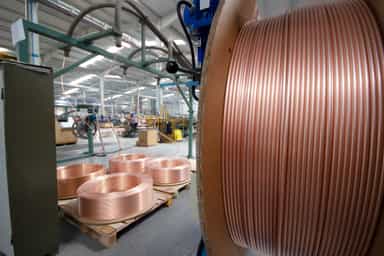
Copper touched $13,392.50 on Wednesday — its highest since March 2 — before profit-taking pulled it back. The Yangshan copper premium has surged 270% since end-January to $74/ton, signalling reviving Chinese import appetite. Citi raised its near-term copper forecast to $13,000/ton, citing reduced tail risk from the conflict. Aluminium is in crisis territory: Wood Mackenzie projects a deficit of up to 4 million tons this year after missile damage to Emirates Global Aluminium's Al Taweelah smelter and hits to Aluminium Bahrain. LME stocks are under 400,000 tons, with much of that Russian-origin and unusable by Western buyers. The cash-to-three-months spread blew out to $95.50 backwardation, the tightest since 2007. Indonesia's nickel smelter group FINI warned that a new ore pricing formula effective Wednesday will significantly raise production costs, adding $600/ton for RKEF processing and up to $2,600/ton for battery-grade nickel products. Sulphur supply disruptions from the Middle East — which accounts for 24% of global production — continue to support both copper and nickel processing cost concerns. Ivanhoe Mines reported strong demand for sulphuric acid in the DRC, selling at around $500/ton in Q1.
Precious Metals
Gold settled at $4,823.60 on Wednesday after touching a one-month high, as peace deal optimism reduced safe-haven demand. The metal has fallen over 8% since the war began, caught between its inflation-hedge appeal and the prospect of higher-for-longer rates. This morning gold is back up 0.9% to around $4,831, supported by a weaker dollar and easing Treasury yields. Silver faces a sixth consecutive year of structural deficit, with 762 million ounces drawn from stocks since 2021. Metals Focus warned that risks of another London liquidity squeeze remain, with only 28% of London vault holdings potentially available to support the market. Spot silver rose 2% to $80.61 in early Asian trade.
Steel
China's crude steel output fell 6.3% year-on-year in March to 87.04 million tons — the lowest March figure since 2020 — as rising feedstock costs driven by the Iran war squeezed margins. Only 41% of Chinese steelmakers operated profitably in March versus 53% a year earlier. Exports dropped 12.6% year-on-year, hit by both the conflict and Beijing's new export licence regime. The World Steel Association cut its global demand forecast, partly due to the war slashing Middle Eastern consumption. In Europe, Voestalpine upsized its convertible bonds due 2028 by €35 million to €250 million, while Britain confirmed automotive and steel sectors will be eligible for expanded energy bill relief.
Rare Earth Metals
The DRC is tightening control over critical minerals with strategic reserves, according to the Financial Times. U.S. Treasury Secretary Bessent called on the World Bank to accelerate support for critical minerals projects to diversify supply chains away from China, which controls over 90% of rare earth supply. Iondrive announced advances in U.S.-focused rare earth recycling technology. These moves reflect an intensifying Western push to reduce dependence on Chinese supply amid ongoing trade tensions.
Forex
The dollar index slipped to its lowest level in over six weeks, down for an eighth consecutive session as peace deal optimism eroded safe-haven demand. The euro edged toward $1.181, extending its winning streak to nine days and approaching its strongest level since the war began. Sterling held firm at $1.355. China's onshore yuan traded around 6.82 per dollar, with analysts maintaining the currency's long-term appreciation trend is intact. For European scrap traders, the weaker dollar provides a modest tailwind for dollar-denominated metal prices when converted to euros, though the effect is partially offset by the euro's own strength.
Watch Today
Euro zone final March HICP data is due and could influence ECB rate expectations. UK GDP, industrial output and trade data for February will be closely watched given Britain's energy cost pressures. TSMC reports quarterly earnings — a 50% profit surge is expected — which could set the tone for risk appetite. Netflix and PepsiCo also report. Fed speakers Williams and Miran are scheduled, while Trump has flagged direct Israel-Lebanon talks for today, a potential catalyst for further de-escalation trades.
Deel